Srinagar, Sep 27 (KNS): Former Jammu and Kashmir chief minister Ghulam Nabi Azad has said the National Conference made a “political mistake” by linking its Assembly resolution on restoration of statehood with references to the erstwhile constitutional arrangement, arguing that a separate resolution confined to statehood could have secured broader political support.
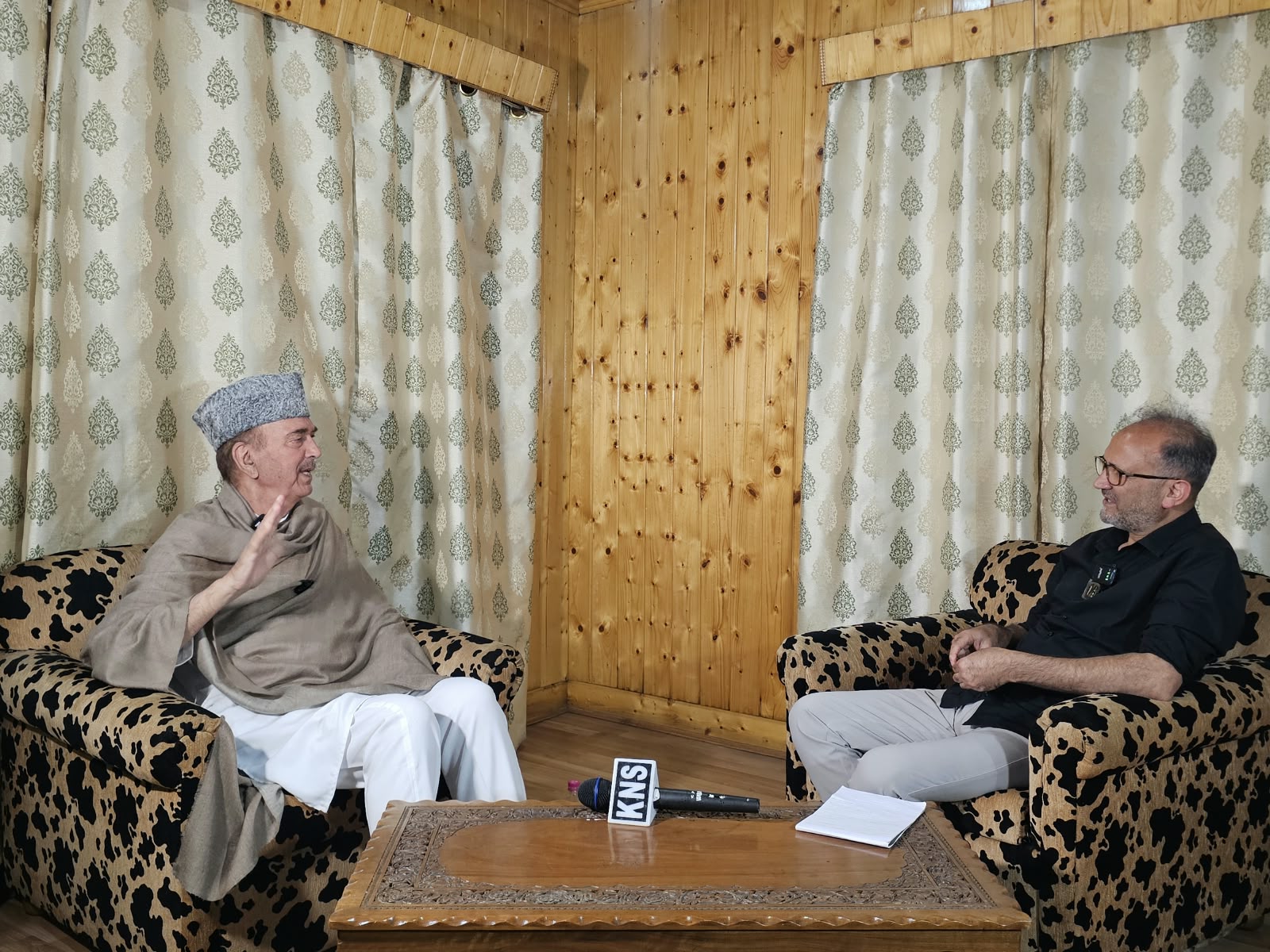
In an exclusive conversation with Kashmir News Service (KNS) , Azad said the resolution brought by the NC was, in principle, a good step because restoration of statehood was a demand shared across Jammu and Kashmir. However, he said the issue should have been separated from the questions surrounding Article 370 and Article 35A.
Azad said the reference to the earlier resolutions gave the Opposition an opportunity to shift the Assembly debate away from the narrower question of restoring statehood.
His comments come after Chief Minister Omar Abdullah moved a resolution seeking the “immediate and urgent restoration” of full statehood to J&K. The resolution states that it is in addition to the Assembly’s resolutions of June 26, 2000 and November 6, 2024.
Azad said the statehood demand should have been pursued separately so that every political party would have been compelled to take a clear position on it.
He said opposition to a resolution seeking only statehood would have been politically difficult for any party to justify before the people, whereas combining it with the contentious issues of 2019 allowed room for disagreement.
“If they had brought only statehood, every political party would have been included. Any political party voting against statehood would have been exposed before the public,” he said, according to his account of the political calculation.
Azad said restoration of statehood was not a party-specific demand and maintained that people across Jammu and Kashmir wanted the erstwhile state status restored.
He said the elected Assembly had a legitimate basis to raise the issue because it represented the people of both regions and had a clear mandate.
Azad also recalled the Centre’s repeated commitment to restore statehood. He said that when he was Leader of the Opposition in the Rajya Sabha, the government had indicated that statehood would be restored at an “appropriate time”.
He said he had pressed for statehood to be restored before Assembly elections, but the Centre had maintained that it would be done after the elections.
With the elections now nearly two years behind, Azad said the Assembly was justified in raising the issue again.
Azad said his own position on Article 370 and Article 35A had been politically costly, particularly during the 2024 elections.
Recalling the first public meeting he held in Baramulla after launching his party, Azad said he had told people that statehood could be restored by the Centre but that he could not promise restoration of Article 370 and Article 35A.
Click Here To Follow Our WhatsApp Channel
He said he had taken that position because he did not want to make promises that he believed could not be fulfilled.
Azad said the position spread beyond Kashmir and became an issue during the 2024 elections, contributing to the setback suffered by his party.
He said political parties opposed to the BJP did not necessarily share his assessment on Article 370, but he chose to state what he believed was politically achievable rather than make a promise for electoral gain.
Azad recalled that he had also publicly questioned whether any political party could realistically secure the parliamentary numbers required to restore Article 370.
Azad said political parties should first concentrate on restoration of statehood and deal with other constitutional and political questions separately.
He also said that restoration of statehood would itself return important administrative and political powers to the elected government and could help resolve several problems that currently arise from the Union Territory structure.
He linked the issue to governance and development, saying J&K was facing unemployment, drug abuse, inflation and difficulties for young people and workers.
Azad said he was not claiming that restoration of statehood would automatically end unemployment, but argued that a state government would have greater control over matters affecting development and administration.
Azad also linked the statehood issue to what he described as the problem of two centres of authority in the present Union Territory arrangement.
He said the issue was not about whether the Lieutenant Governor’s administration was doing good or bad work, but about the confusion created when people were referred from one authority to another for resolution of their problems.
According to Azad, restoration of statehood would remove this situation by bringing greater clarity to the chain of governance.
He said ordinary people often approach one office only to be told that the matter falls under another authority, and are consequently left frustrated.
Azad said he had personally encountered people seeking help despite not having enough money even for bus or train travel to Delhi.
Azad said he was now largely away from active electoral politics and was not making his remarks with an immediate electoral objective.
He said he considered himself politically independent and was not speaking against any particular party or leader.
Azad said his criticism of the NC resolution was based on his experience in Parliament and government, particularly his experience of parliamentary affairs and building consensus.
He said political parties did not have to accept his advice, but maintained that his assessment came from his understanding of how parliamentary resolutions are framed, how support is built and how political consensus is secured.(KNS)
J&K,National,City,Tourism,Crime,Business,Sports,International,Health,Condolence,Opinion,